Health Insurance Company Ripoffs - Real cases YOU WON'T BELIEVE! Nurses, Doctors and Surgeons Employed by the Insurance Companies Who Have Never Seen or Examined Patients, Denying Patients Treatment & Surgeries Based Solely on Reading Reports and Arbitrary Insurance Guidelines.
YOU MAY BE NEXT! YOU NEED TO FIGHT BACK!
*All Cases Presented on this site Have Been Done So
With Patient Permission and Are HIPPA Compliant!
When insurance companies deny the mentally ill the treatment their doctors prescribe, seriously ill people are often discharged, and can be a danger to themselves or others.
"...Some nameless, faceless doctor is making this decision.
And I was furious. Because basically to me he was
playing God with my daughter's life.
Editor's Note: A statement from Dr. Samuel Nussbaum, chief medical officer, Anthem, Inc.
"Mental illness impacts millions of Americans, and is a serious medical issue that demands the attention of the entire country. Throughout the care of these individuals, our behavioral health professionals explored and provided the patients and families numerous care options that went beyond their covered benefits. In our experience, successful outcomes require a partnership between patients, families, medical professionals and health plans. As a company, we are dedicated to working together to help those whose lives are affected."
Dr. Jeff (Jeffery) Jack's denial rate averaged '92 percent' in one six month period in 2011. But that was typical among 11 reviewers contracted by Anthem. Some of them had denial rates of 95 and 100 percent.
POSTSCRIPT: Following the 60 Minutes piece, Anthem placed Dr. Jack on administrative leave. He is no longer doing peer reviews. He remains on Anthem's payroll, and continues to be anAnthem employee.Dr. Jack's boss, Aron Halfin, was terminated following the 60 Minutes story.
Anchor and Managing Editor,
"CBS Evening News;"
Correspondent, "60 Minutes"
“We spent $2.8 trillion in 2012 on healthcare. This is $750 billion or 27% more than the per capita costs of healthcare in other developed countries, yet WHO ranks our healthcare system’s performance 37th in the world.” According to CMS our National Healthcare Expenditure (NHE) is projected to hit
$3.207 trillion this year.
“Between 25-30% of all US healthcare dollars go to pay for ADMINISTRATION.” The US Healthcare System is the most expensive healthcare system on earth. A study done by Harvard Medical School and Cambridge Health Alliance found that nearly 45,000 deaths occur annually in our country due to lack of healthcare access.
“Steven Brill, writing in Time magazine, found that drug prices are so inflated under the current healthcare system that if pharmaceutical prices were controlled to the same degree that they are in other developed countries, we would save more than $90 billion annually and $25 billion/year in Medicare/tax payer savings..”
Last November 19th, Virginia State Senator Creigh Deeds was slashed and stabbed repeatedly by his own son. Gus Deeds was 24 years old and had been struggling with mental illness. He and his father had been in an emergency room just hours before the attack but didn’t get the help that they needed. The story of what went wrong with his medical care exposes a problem in the way that America handles mental health.
$765,000,000,000, or 30% of all U.S. healthcare costs, each year is wasted. A 2011 Institute of Medicine (IOM) study, “The Healthcare Imperative: Lowering Costs and Improving Outcomes,” indicated that of the $2.5 trillion spent on domestic healthcare costs in 2009, $765 billion (or 30%) was attributable to preventable costs. These costs include fraud, unnecessary services, inefficiently delivered services, and excessive administration costs. At the current growth rate, healthcare costs are expected to skyrocket to an unsustainable $4.5 trillion in 2019.
Internal Appeal: If your claim is denied or your health insurance coverage cancelled, you have the right to an internal appeal. You may ask your insurance company to conduct a full and fair review of its decision. If the case is urgent, your insurance company must speed up this process.
External Review: You have the right to take your appeal to an independent third party for review. This is called external review. External review means that the insurance company no longer gets the final say over whether to pay a claim.
(These Sample Letters Are In Microsoft Word Format)
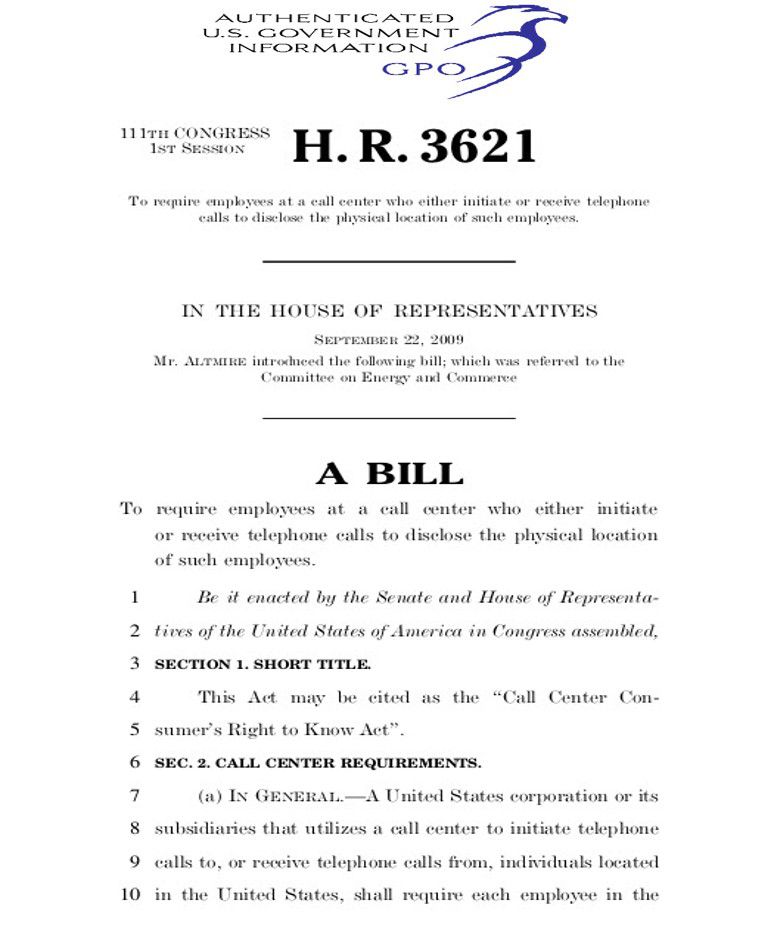
The Call Center Consumer's Right to Know Act - Directs each U.S. corporation or subsidiary that utilizes a call center to initiate telephone calls to, or receive calls from, individuals located in the United States to require each call center employee to disclose the physical location of such employee at the beginning of such call. Requires such corporation or subsidiary to annually certify to the Federal Trade Commission (FTC) their compliance with such requirement. Subjects noncomplying corporations or subsidiaries to such civil penalties as the FTC may prescribe.
Directs the FTC to prescribe rules for effective monitoring
and compliance with such requirement.
Senator Susan Collins (R-ME) and Senator laire McCaskill (D-MO) who together lead the Senate Special Committee on Aging, have announced a bipartisan Senate investigation into pharmaceutical drug pricing. To start their investigation, they have requested documents and information from four pharmaceutical companies: Valeant Pharmaceuticals; Turing Pharmaceuticals; Retrophin, Inc.; and Rodelis Therapeutics. Representative Elijah Cummings (D-M), the ranking member of the committee, has formed a task force – the Affordable Drug Pricing Task Force to engage in "meaningful action to combat the skyrocketing costs of pharmaceuticals."
“Cycloserine, a drug used to treat dangerous multidrug-resistant tuberculosis, was increased in price to $10,800 for 30 pills
from $500 after its acquisition by Rodelis Therapeutics.” After intense public pressure, Rodelis agreed to return the drug to its
former owner, a nonprofit organization
affiliated with Purdue University."
“Privately-held Turing and its Chief Executive Martin Shkreli (32 yo) sparked outrage in September after it acquired the rights to a 62-year-old drug, Daraprim, and raised the price more than 5,000 percent to $750 a pill from $13.50. Shkreli, arrested by feds in New York for fraud, was subpoenaed to testify
before House lawmakers.”
“Two members of Congress investigating generic drug price increases wrote to
Valeant Pharmaceuticals after that
company acquired two heart drugs,
Isuprel and Nitropress, from Marathon Pharmaceuticals and promptly raised
their prices by 525 percent and
212 percent respectively.”
“Doxycycline, an antibiotic, went from $20 a bottle in October 2013 to $1,849 by April 2014, according to the two lawmakers..”
Horizon Pharma's Vimovo pain tablets now cost 600 percent more.
URL Pharma turned the ancient anti-gout drug colchicine into Colcrys, boosting the price from pennies per pill to $5 each; the price of Mallinckrodt's Ofirmev pain injections are up 250 percent.
“ According to Express Scripts Prescription Price IndexOverall, since 2008, "The average price of brand drugs has almost doubled, while the average price of generic drugs
has been cut roughly in half.”"
Senator Susan Collins (R-ME)
413 Dirksen Senate Office Building
Washington, DC 20510
Main: (202)224-2523
Fax: (202)224-2693
Senator Claire McCaskill (D-MO)
730 Hart Senate Office Building
Washington, D.C. 20510
Phone: (202) 224-6154
Fax: (202) 228-6326
Representative Elijah Cummings (D-MD)
730 Hart Senate Office Building
Washington, D.C. 20510
Phone: (202) 224-6154
Fax: (202) 228-6326
Americans filled 4.3 billion prescriptions and doled out nearly $374 billion on medicine in 2014, according to new data from the IMS Institute for Healthcare Informatics. The data shows that American men and women’s spending on medicine hit the highest level since 2001, up 13% in 2014 compared with the year before.
In 2013, there were an estimated 29,718 cases of acute hepatitis C virus infections reported in the United States. An estimated 3.5 million people in the United States have chronic hepatitis C infection. Approximately 15,000 people die every year from Hepatitis C related liver disease.
"Hepatitis C treatment no longer means
daily injections and low cure rates that characterized the disease in the past. Now, newer oral drugs on the market require only a 12-week course, but their prices are shocking. Gilead Sciences has two drugs for hepatitis C, both costing astronomical amounts: one drug, Harvoni, costs $95,500 for 12 weeks, and the other, Sovaldi, costs $84,000.
That’s $1,000 per pill."
3.2 million Americans live with chronic hepatitis C, a liver disease primarily spread via the blood of an infected person. A new business deal may mean more affordable care. Globally, an estimated 170 million people are living with HCV infection (chronically infected), and almost 500,000 were estimated to have died from HCV-related liver disease in 2010.
Read More Here: CDC
"Another drug called Viekira Pak, developed by the pharmaceutical company AbbVie, got the green light from the U.S. Food and Drug Administration on Friday, Dec. 19. But many were disappointed upon discovering that the drug would cost $83,319 for a 12-week course, only slightly less than Sovaldi. The medical community had hoped that market competition would drive prices
much, much lower."
Anthem surprised Wall Street this morning with news its fourth-quarter profits fell 64% as the company was hit with higher than-expected medical expenses in its individual health insurance business, which includes plans offered on public exchanges under the Affordable Care Act.
The large health insurer, which operates Blue Cross and Blue Shield plans in 14 states, said benefit expenses soared nearly 10% to $16.3 billion, according to its earnings report. That caused profits to fall to $180.9 million in the fourth quarter of 2015 compared to $506.7 million.
